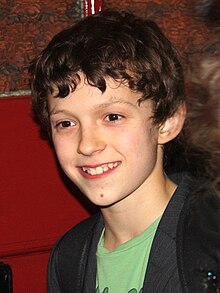
Thomas Edward Patrick "Tom" Brady, Jr. (born August 3, 1977), nicknamed Tom Terrific, is an American football quarterback for the New England Patriots of the National Football League (NFL).
After playing college football for the University of Michigan, Tom Brady was drafted by the Patriots in the sixth round of the 2000 NFL draft. In Brady's 13 full seasons as a starter (he missed nearly all of 2008 with a torn ACL), the Patriots have earned six trips to the Super Bowl, winning four. Brady has won three Super Bowl MVP awards, two league MVP awards (2007, 2010), has been selected to ten Pro Bowls, and has led the Patriots to more division titles than any other quarterback in NFL history, with twelve. Brady is fifth on the all-time list for career passing yards and fifth for career touchdown passes. His career postseason record is 21–8; his playoff win total is the most in NFL history. He helped set the record for the longest consecutive win streak in NFL history with 21 straight wins over two seasons (2003–2004). He also set the record for most consecutive playoff wins with 10, and in 2007 led the Patriots to the first undefeated regular season since the institution of the 16-game schedule. He has thrown for more passing yards and touchdowns than any quarterback in NFL postseason history, and has the sixth highest career passer rating of all time (95.9) among quarterbacks with at least 1,500 career passing attempts.
Tom Brady is considered among the greatest quarterbacks of all time. He and Joe Montana are the only two players in NFL history to win the NFL Most Valuable Player and Super Bowl MVP awards multiple times. Brady is the only quarterback to lead his team to six Super Bowls, and holds the record for the most total Super Bowl touchdown passes. He was named the NFL MVP in 2007 and 2010 (becoming the first player since 1986 to be unanimously chosen as MVP) as well as the 2007 Male Athlete of the Year by the Associated Press, the first NFL player to be so honored since 1990. After the 2010 season, Brady was ranked as the top player in the NFL Top 100, a poll of league players. He also became the first quarterback to throw for 50 or more touchdowns in a season. In 2010, he set the NFL record for consecutive passes without an interception (358), and broke his own record for the highest season touchdown to interception ratio, among players who have started a full season, at 9:1.
Brady and Patriots head coach Bill Belichick have combined to form the most successful quarterback-coach tandem in NFL history, winning 160 regular season games and 21 postseason games together, as well as appearing in six Super Bowls together, all NFL records.
Early years
Tom Brady was born in San Mateo, California, the only son and fourth child of Galynn Patricia (née Johnson) and Thomas Brady, Sr. He has three older sisters. He was raised Catholic, and is of Irish descent on his father's side and of Polish, Norwegian, and Swedish descent on his mother's side. Brady regularly attended 49ers games at Candlestick Park in the 1980s, where he became a fan of quarterback Joe Montana; since then, Brady has mentioned Montana as one of his inspirations and an idol. One of the games Brady attended was the 1981 NFC Championship against the Dallas Cowboys, in which Montana threw The Catch to Dwight Clark, with Brady only being four-years-old at the time. Brady attended football camp at the College of San Mateo as a kid, where he learned to throw the football from camp counselor, and American football quarterback, Tony Graziani. Brady grew up as a Los Angeles Lakers and Boston Celtics fan.
Brady attended Junípero Serra High School in San Mateo, California, graduating in 1995 at St. Mary's Cathedral. While at Serra, Brady played football, basketball, and baseball. He played against Bellarmine College Preparatory rival Pat Burrell in both football and baseball. Brady was drafted as a catcher in the 18th round of the 1995 MLB Draft by the Montreal Expos.
During the summer of 1998 and 1999, Brady was an intern at Merrill Lynch.
In 2004, Brady was inducted into the school's Athletic Hall of Fame. When Brady revisited two weeks after Super Bowl XLVI in 2012, it was announced by school administration that the school had named the football stadium Brady Family Stadium.
College career
Brady played college football for, and graduated from, the University of Michigan. He was a backup quarterback for his first two years, while teammate and future NFL quarterback Brian Griese led the 1997 Wolverines to an undefeated season capped by a victory in the Rose Bowl and a share of the national championship. When he enrolled at Michigan, Brady was seventh on the depth chart and had an intense struggle to get some playing time. At one point, Brady hired a sports psychologist to help him cope with frustration and anxiety and even considered transferring to California. He worked closely with assistant athletic director Greg Harden, who met with Brady every week to build his confidence and maximize his performance on the field. Brady told 60 Minutes in 2014: ""He will always be somebody I rely on for sound advice and mentorship. He has helped me with my own personal struggles in both athletics and in life. Greg really pushed me in a direction that I wasn’t sure I could go." Brady battled for the starting job with Drew Henson, ultimately starting every game in the 1998 and 1999 seasons under Michigan head coach Lloyd Carr. During his first full year as starter, he set Michigan records for most pass attempts and completions in a season (214). Brady was All-Big Ten honorable mention both seasons and team captain his senior year. The Wolverines won 20 of 25 games when he started, and he set a school record for completions in a 31-16 loss against Ohio State in 1998, a season in which Michigan shared the Big Ten Conference title. Brady capped that season with a win over Arkansas in the Citrus Bowl. In the 1999 season, Brady had to once again hold off Henson for the starting job. The two platooned over the season's first seven games, with Brady playing the first quarter, Henson the second and Carr then deciding upon a quarterback for the second half. The 1999 Michigan Wolverines started off 5-0, including a 26-22 win over Notre Dame and a road win against eventual powerhouse Wisconsin. Against Michigan State, Brady was not chosen to play the second half but was reinserted into the game with Michigan down 17; he nearly led Michigan all the way back before losing 34-31. After a 300-yard passing game the following week, Carr went exclusively with Brady for the remainder of the season. Brady went on to lead Michigan to multiple 4th-quarter comebacks, including a remarkable 31-27 win against Penn State, and leading them out of a close game against Indiana, 34-31, heading into the regular season's final game, winners of three straight, earning him the moniker of "Comeback Kid". Brady concluded the regular season against Michigan's rival, Ohio State, in a dramatic game, with a trip to the Orange Bowl on the line. With five minutes left, tied 17-17, Brady led Michigan to the winning score. He then led Michigan to an overtime win in the Orange Bowl over Alabama, throwing for 369 yards, four touchdowns, leading the team back from a pair of 14-point deficits in regulation (14-0 in the first half, and 28-14 in the second). He threw the game-winning score on a bootleg to tight end Shawn Thompson. Michigan then won when Alabama missed an extra point following its own touchdown.
Professional career
New England Patriots (2000–present)
2000 season
Brady was selected with pick #199, a compensatory pick, in the sixth round of the 2000 NFL draft. According to Michael Holley's book Patriot Reign, the Patriots were considering Brady and Tim Rattay, both of whom had received positive reviews from then-quarterbacks coach Dick Rehbein. Ultimately, the Patriots front office chose Brady. Considering his later achievements, many analysts have called Brady the best NFL draft pick of all time.
Brady started the season as the fourth string quarterback, behind starter Drew Bledsoe and backups John Friesz and Michael Bishop; by season's end, he was number two on the depth chart behind Bledsoe. During his rookie season, he was 1-of-3 passing, for six yards.
2001 season
The Patriots opened the season with a 23–17 loss at Cincinnati, with Bledsoe as the starting quarterback. Their second game, and home opener, on September 23, was against their AFC East rival, the New York Jets. Bledsoe was again the starter, when in the fourth quarter he suffered internal bleeding after a hit from Jets linebacker Mo Lewis. Bledsoe returned for the next series, but was replaced with Brady for the Patriots' final series of the game. New York would hold on to win, 10–3, and the Patriots fell to 0–2 on the season. Brady was named the starter for the season's third game, against the Indianapolis Colts. In his first two games as starter, Brady posted unspectacular passer ratings of 79.6 and 58.7, respectively, in a 44–13 victory over the Colts (in their last season in the AFC East) and a 30–10 loss to the Miami Dolphins.
In the Pats' fifth game, Brady began to find his stride. Trailing the visiting San Diego Chargers 26–16 in the fourth quarter, Brady led the Patriots on two scoring drives to force overtime, and another in overtime to set up a winning field goal. Brady finished the game with 33 pass completions on 54 attempts, for 364 yards, and two touchdowns. The following week, Brady again played well during the rematch at Indianapolis, with a passer rating of 148.3 in a 38–17 win. The Patriots went on to win eleven of the fourteen games Brady started, and six straight to finish the regular season, winning the AFC East and entering the 2001–02 NFL playoffs with a first-round bye. Brady finished with 2,843 passing yards and 18 touchdowns and earned an invitation to the 2002 Pro Bowl.
2001 postseason
In Brady's first playoff game, against the Oakland Raiders, he threw for 312 yards and led the Patriots back from a ten-point fourth-quarter deficit to send the game to overtime, where they won on an Adam Vinatieri field goal. A controversial play in that game came when, trailing by three in the fourth quarter, Brady lost control of the ball after being hit by Raiders' cornerback, and fellow Wolverine Charles Woodson. Oakland initially recovered the ball, but, citing the "tuck rule," which states that any forward throwing motion by a quarterback begins a pass even if the quarterback loses possession of the ball as he is attempting to tuck it back toward his body, referee Walt Coleman overturned the call on instant replay, ruling it an incomplete pass rather than a fumble.
In the AFC Championship Game against the Pittsburgh Steelers, Brady injured his knee, and was relieved by Bledsoe. The Patriots won the game and were immediately instituted by Las Vegas oddsmakers as 14-point underdogs against the NFC champion St. Louis Rams in Super Bowl XXXVI.
The score was tied with 1:21 left in the Super Bowl and the Patriots were at their own 17—with no timeouts—when sportscaster and Super Bowl-winning coach John Madden said he thought the Patriots should run out the clock and try to win the game in overtime. Instead, Brady drove the Patriots' offense down the field to the Rams 31 before spiking the ball with seven seconds left. The Patriots won the game by a score of 20–17, after Adam Vinatieri made another field goal as time expired. Brady was named MVP of Super Bowl XXXVI while throwing for 145 yards, one touchdown, and no interceptions, becoming the then-youngest quarterback to ever win a Super Bowl. A possible quarterback controversy was averted when Bledsoe was traded to the Buffalo Bills in the offseason, cementing Brady's status as the starter.
2002 season
Brady and the Patriots finished the year at 9–7, tied with the New York Jets and Miami Dolphins for the best record in the division; however, the Jets won the division on the third tiebreaker, and the Patriots missed the playoffs.
Although posting a career-low single-season rating of 85.7, Brady threw for a league-leading 28 touchdown passes and 921 more yards than in 2001, though his fourteen interceptions would turn out to be a career high. However, Brady played much of the second half of the season with a shoulder injury, and New England head coach Bill Belichick has since indicated that if the Patriots had made the playoffs, Brady would not have been able to play in the first game due to that injury.
2003 season
In the 2003 NFL season, after a 2–2 start, Brady led the Patriots to twelve consecutive victories to finish the season, thus winning the AFC East. Statistically, Brady's strongest game of the season was against Buffalo, when he achieved a season-high quarterback rating of 122.9. Brady finished with 3,620 passing yards and 23 touchdowns, and was third in NFL MVP voting to co-winners Peyton Manning and Steve McNair.
2003 postseason
In the first two rounds of the playoffs, the Patriots defeated the Tennessee Titans and Indianapolis Colts. On February 1, 2004, Brady led the Patriots to a 32–29 victory over the NFC champion Carolina Panthers in Super Bowl XXXVIII and was named Super Bowl MVP for the second time. During the game, Brady threw for 354 yards with three touchdowns and set the record for most completions by a QB in a Super Bowl (32). With 1:08 left in the fourth quarter and the score tied 29–29, Brady engineered a drive to put the Patriots in position for the game-winning field goal.
2004 season
During the 2004 season, Brady helped the Patriots set an NFL record with 21 straight wins dating from the previous year, an accomplishment honored in the Pro Football Hall of Fame (though for official records, the NFL considers it an 18-game regular season winning streak; it does not count playoff games). New England's 14–2 record equalled that of their 2003 season, as well as tied the best regular-season record ever for a defending champion. The Patriots also won the AFC East divisional title for the third time in four years. Brady threw for 3,692 yards and 28 touchdowns, with a 92.6 passer rating, and was voted to his second Pro Bowl.
2004 postseason
In the AFC playoffs, Brady led the Patriots to victories over the Indianapolis Colts and the Pittsburgh Steelers. Brady played his best game of the year in Pittsburgh despite requiring intravenous treatment the previous night when he ran a temperature of 103 degrees. Against the NFL's best defensive team, he recorded a quarterback passer rating of 130.5, his highest of the season. On February 6, 2005, the Patriots narrowly defeated the Philadelphia Eagles by a score of 24–21, to win Super Bowl XXXIX. Brady threw for 236 yards and two touchdowns while capturing the Patriots' third championship in four years.
2005 season
During the 2005 season, the Patriots were forced to rely more on Brady's passing, due to injuries suffered by running backs Corey Dillon, Patrick Pass, and Kevin Faulk.[60][61] Brady also had to adjust to a new center and a new running back: Heath Evans. The results were positive; Brady finished first in the league with 4,110 passing yards and third in the league with 26 touchdowns. At 92.3, his 2005 passer rating was the second-highest of his career at the time, although he equalled his career high for interceptions with fourteen. He rushed for 89 yards and fumbled a career-low four times. He and the Patriots finished with a 10–6 record, winning their third straight AFC East title.
2005 postseason
In the playoffs, Brady led the Patriots to a 28–3 victory over the Jacksonville Jaguars in the wild card round; however, on January 14, 2006, the Patriots lost 27–13 to the Denver Broncos at INVESCO Field. Brady threw for 341 yards in the game with one touchdown and two interceptions, in the first playoff loss of his career. After the season's end, it was revealed that Brady had been playing with a sports hernia since December. Linebacker Willie McGinest commented on it and said he knew, but Brady continued on playing.
Brady on the sideline with teammates Randy Moss and Jabar Gaffney, after throwing for his record-breaking 50th passing touchdown of the season at Giants Stadium.
2006 season
Brady led the Patriots to a 12–4 record and the fourth seed in the AFC playoffs. In the regular season, Brady threw for 3,529 yards and 24 touchdowns. He was not among the players initially selected to the Pro Bowl, although he was offered an injury-replacement selection when Philip Rivers was forced to withdraw (which he declined).
2006 postseason
In the postseason, the Patriots first hosted their division rivals, the New York Jets, in the wild-card round. The Patriots defeated the Jets 37–16, as Brady went 22–34 for 212 yards and two TDs. In the divisional round, the Patriots traveled to San Diego to take on the Chargers. This was Brady's first playoff game in his home state of California. Brady and the Patriots struggled against the Chargers, whom many had picked as favorites to win Super Bowl XLI. With eight minutes left in the fourth quarter and the Patriots down by eight points, Brady and the Patriots started a key drive that would ultimately decide the game. After a 49-yard pass play to Reche Caldwell, a Stephen Gostkowski field goal gave the Patriots a 24–21 win.
In the AFC championship, the Patriots faced the Indianapolis Colts. The Patriots and Colts had faced each other twice in the previous three postseasons at Foxborough; this game, however, was played at Indianapolis. The Patriots led at halftime, 21–6; however, the Colts staged a comeback, culminating in a last minute interception thrown by Brady, and the Patriots losing the game to the Colts, 34–38.
2007 season
Playing with a dramatically overhauled receiver corps—in the 2007 offseason, the Patriots acquired wide receivers Donté Stallworth, Wes Welker, Kelley Washington and Randy Moss; tight end Kyle Brady; and running back Sammy Morris—Brady enjoyed what some sports writers have described as the best season ever by a quarterback. The average score of a 2007 Patriots regular season game would be 37–17 by the end of the year. Brady led the Patriots to the first 16–0 regular season record in league history, outscoring opponents by more than a 2-to-1 margin, but also attained numerous career, franchise, and NFL records and milestones in the process. While away at Dallas, he had a career-high five passing touchdowns in a 48–27 win. The win tied him with Roger Staubach for the most wins ever by a starting quarterback in his first 100 regular-season games, with 76. The next week, in part of a 49–28 win at Miami, he had yet another record day, with six passing touchdowns, setting a franchise record. He also had the first perfect passer rating of his career. Two weeks laters, as part of a come-from-behind 24–20 victory at Indianapolis, he threw for another three touchdowns, the ninth consecutive game in which he had done so, breaking Peyton Manning's NFL record of eight. During the last game of the year, Brady threw two touchdown passes; his second touchdown was his 50th, breaking Peyton Manning's 2004 record of 49.[citation needed]
Brady finished the season with 4,806 passing yards, 50 touchdown passes, and only 8 interceptions. It was unanimously voted the greatest passing season of all time by ESPN in 2013. His 50:8 touchdown to interception ratio was a then NFL record (it currently is the third best). He became the first quarterback to pass for 50 touchdowns in a season and his 117.2 passer rating is currently the fourth highest in a single season. His 8.7% touchdown passing percentage is currently the third highest ever in a season. He led the Patriots to becoming the first team to ever go undefeated in the regular season since the 16 game schedule was enforced and directed an offense that scored a then NFL record 589 points and 75 total touchdowns. Those records stood until they were eclipsed by the 2013 Broncos. The team's 50 total touchdown passes is the fourth most ever in a season. For his efforts, Brady was named the Most Valuable Player of this season, as well as Offensive Player of the Year. He was also honored by the Associated Press as their Male Athlete of the Year, the first time an NFL player has been so honored since Joe Montana won the award in 1990.
2007 postseason
In the Patriots' first playoff game, an AFC Divisional game against Jacksonville, Brady began the game with an NFL postseason record sixteen consecutive completed passes, and finished the game with 26 completions in 28 attempts, a completion rate of 92.9%. That mark is the highest single-game completion percentage (for passers with at least 20 attempts) in NFL history, regular season or postseason. With the win, the Patriots matched the Dolphins as the only team to win 17 consecutive games in one season.
Statistically, Brady did not fare as well in the AFC Championship Game against the San Diego Chargers, throwing three interceptions (including his first interception in the red zone since the playoff loss to Denver). Nevertheless, the Patriots won their 18th game of the season, 21–12, to advance to the Super Bowl for the fourth time in seven seasons. Brady, with the 100th win of his career, also set an NFL record for the fewest games needed by a starting quarterback to do so: his 100–26 record is sixteen games better than Joe Montana's. In Super Bowl XLII, Brady was pressured heavily and sacked five times. The Patriots did manage to take the lead with a Brady touchdown to Moss with less than three minutes remaining in the fourth quarter, but the Giants were able to score a last-minute touchdown to upset the Patriots 17–14, taking away what would have been the first perfect season since the NFL expanded its regular season to 16 games.
Brady in action against the Washington Redskins on August 28, 2009.
2008 season
Brady did not play in any games during the 2008 preseason or in the 2008 Pro Bowl due to a right foot injury from the previous AFC Championship game. In the Patriots' 2008 season opener against the Kansas City Chiefs at Gillette Stadium, Brady's left knee was seriously injured midway through the first quarter on a hit by Chiefs safety Bernard Pollard; he left the game and did not return. The team later confirmed that Brady would require surgery, and it would prematurely end his 2008 season. Brady tore both his anterior cruciate ligament and medial collateral ligament. The injury ended Brady's streak of 111 consecutive starts (seventh in the list of most consecutive starts by an NFL quarterback, behind Brett Favre, Peyton Manning, Ron Jaworski, and Joe Flacco). Dr. Neal ElAttrache performed the anterior cruciate ligament reconstruction at the Los Angeles Kerlan-Jobe Orthopaedic Clinic October 6, using Brady's patellar tendon graft to replace the torn ligament, and also repaired his medial collateral ligament, through a separate incision in his left knee. An infection in the wound resulted in further debridement surgery several times since the original procedure. Brady received IV antibiotics for this infection which, at the time, threatened to delay his rehab.
2009 season
Tom Brady in Landover, Maryland, on August 28, 2009, during warmups in a preseason game against the Washington Redskins.
In his first game back from an injury, Brady threw for 378 yards and two touchdowns in the 2009 season opener against the Buffalo Bills. In the final minutes of the game, the Patriots were down 24–13 before Brady and Benjamin Watson connected on two straight touchdowns to lead the Patriots to a 25–24 win. Brady was named the AFC Offensive Player of the Week for the 13th time in his career for his performance.
On October 18, 2009, in an early season snowstorm, Brady set an NFL record against the Tennessee Titans for most touchdowns in a single quarter, throwing five in the second quarter. Brady finished the game with six touchdowns, tying his career best, and 380 yards, completing 29 of 34 attempts, finishing with a nearly perfect passer rating of 152.8. The Patriots' 59–0 victory over the Titans tied the record for the largest margin of victory since the 1970 AFL-NFL merger,[90] and set a record for largest halftime lead in NFL history (they led 45–0).
Brady would finish the 2009 regular season with 4,398 yards passing and 28 touchdowns for a 96.2 rating, despite a broken right ring finger and three fractured ribs, all which were suffered over the course of the season. He was selected as a reserve to the 2010 Pro Bowl and named the 2009 NFL Comeback Player of the Year.
2009 postseason
Brady ended the 2009 season throwing 3 interceptions in a Wild Card playoff loss to the Baltimore Ravens, 33–14, his first career home playoff loss, and the first playoff loss at home by a New England Patriots quarterback since 1978.
2010 season
On September 10, 2010, Brady signed a four-year, $72 million contract extension making him the highest-paid player in the NFL. The extension included $48.5 million in guaranteed money and will likely keep Brady with the Patriots through the 2014 NFL season.
Brady became the quickest to achieve 100 regular season wins by helping his team defeat the Miami Dolphins 41–14 on October 4, 2010.
On November 21, 2010, Brady tied Brett Favre's record of winning 25 consecutive regular-season home starts, in a 31–28 win over the Indianapolis Colts. Brady's last regular-season loss at home was on November 12, 2006, a 17–14 loss to the New York Jets. On December 6, 2010, Brady set an NFL record by winning 26 consecutive regular-season home starts, in a 45–3 victory over the New York Jets.
Brady threw for 3,900 yards with 36 touchdowns and just four interceptions on the season. He had an 111.0 passer rating, giving him, at the time, two of the top five season ratings in NFL history, and making him the first player to finish with a rating above 110 in two different seasons.
Brady was selected as a starter to the 2011 Pro Bowl. However, he pulled out of the game (and was replaced by former backup Matt Cassel of the Kansas City Chiefs) after undergoing surgery for a stress fracture in his right foot dating back to 2008. Brady was also the only unanimous selection for the AP All-Pro Team and was named the 2010 Associated Press NFL Offensive Player of the Year. He won, by unanimous decision, the MVP award for the second time in his career.
2010 postseason
After earning a bye week, the Patriots lost to the New York Jets in the divisional playoffs, 28-21. Brady finished the game 29 of 45 for 299 yards and two touchdowns, with one interception. His one pick ended his NFL record of consecutive passes without an interception at 340.
2011 season
In Week 1 of the 2011 NFL season, Brady threw for 517 yards and 4 touchdowns, with one interception, against the Miami Dolphins, the second time he had thrown for 400 or more yards in a single game.
In the regular season finale against the Buffalo Bills, Brady became the fourth quarterback to throw for 5,000 yards in a single season, finishing with 5,235; it surpassed Dan Marino's longstanding record of 5,084 passing yards, but finished the season second behind Drew Brees' 5,476.
2011 postseason
There's no quarterback I'd rather have than Tom Brady. He's the best. He does so much for us in so many ways on so many different levels. I'm very fortunate that he's our quarterback and what he's able to do for this team. It's good to win with him and all the rest of our players. If that's more than somebody else did, I don't really care about that.
–Bill Belichick
In the Patriots' 45–10 rout of the Denver Broncos in the Divisional round, Brady set a personal postseason best with 363 passing yards, and tied an NFL record shared by Daryle Lamonica and Steve Young, throwing for 6 touchdown passes. The win, his first postseason win since January 2008, gave Brady and Patriots head coach Bill Belichick sole possession of the NFL record for postseason wins by a QB-coach combo with 15. In the AFC Championship game against the Baltimore Ravens, Brady failed to throw a touchdown pass for the first time in 36 games, though he did pass for 239 yards and scored a 1-yard rushing touchdown late in the game. The Patriots were the beneficiaries of a missed field goal from Ravens kicker Billy Cundiff that saw the Brady and Patriots reach their fifth Super Bowl since Brady joined the team. In Super Bowl XLVI, Brady and the Patriots met the New York Giants, meeting in the Championship for the second time in five years. Brady played well, leading a Super Bowl record-tying 96-yard touchdown drive to close the first half and at one point completing 16 passes in the row for a 20/23 mark partway into the third quarter, another Super Bowl record. In all, he recorded two touchdowns, one interception, and was penalized for intentional grounding in the end zone, leading to a crucial safety for the Giants. A final score of 21–17 for the Giants prevented Brady from winning his fourth Super Bowl.
2012 season
Brady started all 16 regular season games of the 2012 NFL season and led the Patriots to a 12–4 record. The Patriot scored 557 total points, the third highest in league history and Brady became the first quarterback to lead his team to 10 division titles. With that point total, the Patriots became the first team to score at least 500 points in a season four different times, with Brady leading all four squads (another record). He finished the season with 4,827 passing yards, 34 touchdowns, only 8 interceptions, and a passer rating of 98.7. It was Brady's third straight season throwing for over 30 touchdowns.
2012 postseason
Brady also started both Patriots play-off games, winning against the Houston Texans. With the victory, Brady surpassed Joe Montana for most career playoff wins, with 17. The Patriots were then upset by the eventual Super Bowl champ Baltimore Ravens, 28–13 in the AFC championship.
On February 25, 2013, Brady and the Patriots agreed on a three-year contract extension, which will keep him with the team through 2017. Peter King called it an "amazing" deal, as Brady took just $27 million in new money over the 2015, 2016, and 2017 seasons, and also noted that it reflected Patriots owner Robert Kraft's desire to make sure Brady retired a Patriot.
2013 season
Tom Brady and the New England Patriots began the season with much upheaval on the offensive side of the ball with the injury of Rob Gronkowski, the arrest of Aaron Hernandez, the departure of Wes Welker to the Denver Broncos and Danny Woodhead to the San Diego Chargers in free agency, and the release of Brandon Lloyd. To replace them, the Patriots signed Danny Amendola in free agency, drafted rookies Aaron Dobson and Josh Boyce, and signed undrafted rookie free agent Kenbrell Thompkins. Despite showing good chemistry with his new receiving corps in the preseason, Brady struggled in the first 2 games of the season completing only 52% of his passes (48 out of 91) and only 3 TD and one interception and passer rating under 75.0 in both games.
In Weeks 3 and 4, Brady completed over 60% of his passes and threw 4 TDs and 1 interception in wins over the Tampa Bay Buccaneers and Atlanta Falcons. Brady, who was in pursuit of Drew Brees' record of at least one touchdown in 54 consecutive games, saw the streak end at 52 games in a Week 5 loss against the Cincinnati Bengals that held him to 197 yards, completing under 50% of his passes (18 out of 38) for the second time in the season. In a Week 6 game against the New Orleans Saints, the Patriots struggled in the first half and bounced back in the second with Brady going 25 out of 43, for 269 yards and a clutch touchdown pass to Kenbrell Thompkins as time expired to pull out the upset over the Saints. The Patriots improved to 5–1 on the season. In Week 6 against the New York Jets, Brady was outplayed by Geno Smith, despite Rob Gronkowski coming back and having 8 catches for 114 yards. Brady completed 47.8% of his passes, marking the third time in the season he went under 50%. With Gronkowski healthy again, the Patriots had wins in Week 7 against divisional rival Miami Dolphins and Week 8 against the Pittsburgh Steelers, with Brady having his best game of the season going 23 out of 33, for 432 yards 4 TD and 0 interceptions, with a nearly perfect passer rating of 151.8 in a 55–31 win. Brady and the Patriots headed to the bye week with a 7–2 record.
In a Week 10 loss to the Carolina Panthers, the Patriots trailed by 4 and Brady, with only 59 second left and three timeouts, drove his offense downfield to Carolina's 18 yard line, and with 3 seconds left, threw a pass to Rob Gronkowski that was intercepted despite the officials calling a defensive pass interference penalty on Luke Kuechly that was waved off. Brady and the 7–3 Patriots began in Week 11 against Peyton Manning and the Denver Broncos, in what was the 14th clash between the two, a series of three dramatic comeback wins. After going to the half trailing by 24, Brady and the Patriots scored 31 unanswered points. The Patriots won after a muffed punt in overtime with a field goal from Stephen Gostkowski. Brady outplayed Peyton Manning, who had been playing at an MVP level, throwing for 344 yards and 3 TDs as Peyton threw for 150 with 1 TD and an interception. After that, the Patriots began their Week 13 and Week 14 matchups trailing in the first half to then pull out comebacks in the 4th quarter. In the Week 15 AFC East clash against the Dolphins, the Patriots could have become, at least temporarily, the number 1 seed in the AFC as well as clinched the AFC East title for 5th season in a row, but this time the 4th quarter comeback was denied as Brady threw an interception as time expired on a potential game winning drive. Brady and the Patriots fell to 10–4. With a Week 16 win over the Baltimore Ravens, Brady collected his 147th win as a starting quarterback and tied Dan Marino for 4th place all time. With the Week 17 win over the Buffalo Bills, Tom Brady tied John Elway for the 3rd place all time in wins as a starting quarterback.
2013 postseason
Brady's Patriots finished the season 12–4, to earn the second seed in the AFC and a first-round bye. In the Divisional Round matchup against the Indianapolis Colts, Brady made his 25th playoff appearance, breaking Brett Favre's career record for playoff appearances by a quarterback (Jerry Rice appeared in 29 playoff games). The following week, the Patriots lost to the Denver Broncos, eliminating Brady and the Patriots from the playoffs.
2014 season
Brady's Patriots once again finished 12-4, this after a late-preseason trade of guard Logan Mankins to Tampa Bay for tight end Tim Wright. Brady started the season with a 33-20 loss to the Miami Dolphins. It was Brady's first opening day loss since 2003. Brady was good for 241 yards and a touchdown. New England rebounded against the Minnesota Vikings, but Brady struggled, throwing for 149 yards and a touchdown in 30-17 win. Against the Oakland Raiders Brady was pressured all day, but threw for 234 yards and a touchdown in 16-9 win. After a 41-14 loss to the Kansas City Chiefs, Brady led New England to back-to-back wins, including his first 300-yard performance of the season, against the Buffalo Bills. Brady then defeated the New York Jets with a 261-yard performance that included 3 touchdowns. The following week, a 51-23 embarrassment of the Chicago Bears saw Brady throw for 354 yards and a season-high 5 touchdowns. After passing for 333 yards, and 257 yards in his next two games against the Denver Broncos and Indianapolis Colts respectively, Brady defeated the Detroit Lions 34-9 with 349 passing yards and 2 touchdowns against only one interception. The Patriots winning streak was put to the test against the Green Bay Packers in week 13. Down 13-0 early, Brady threw for 2 touchdowns, no picks, and 245 yards. Still down 26-21, Brady was unable to give the Patriots their 8th straight victory. After trailing 14-3 at the San Diego Chargers, Brady rallied his team with 317 passing yards, 2 touchdowns, and only one pick, to a 23-14 comeback win. Brady clinched his NFL record 12th AFC East division title with 287 passing yards, 2 touchdowns and a pick. Brady struggled in his final two games, throwing for only 182 yards, a touchdown, and an interception in 17-16 victory against the Jets, and 80 yards in one half of a game against the Buffalo Bills, a 17-9 loss.
2014 postseason
In a 35-31 Divisional Round win over the Ravens, Brady threw for three touchdowns and ran in a fourth, breaking Curtis Martin's club record for rushing touchdowns in the playoffs; Brady also broke Joe Montana's record for playoff touchdowns with 46. After the Ravens scored on their first two possessions, the Patriots were quickly down 14-0. Brady led New England on an 8 play, 78 yard drive, and ran for a score to cut the Raven lead to 14-7. In the second quarter, Brady's 15 yard touchdown pass to Danny Amendola tied the score at 14-14. After getting the ball back, Brady threw an interception at the end of the first half. Joe Flacco capitalized on it by throwing an 11-yard touchdown strike to Owen Daniels to give Baltimore a 21-14 halftime lead. Down 28-14, Brady engineered an 80-yard drive, culminating in a touchdown to Rob Gronkowski to cut the lead to 28-21. With the score tied at 28, Ravens kicker Justin Tucker drilled a 25-yard field goal to give Baltimore a 31-28 4th quarter lead. Brady got the ball back, and threw a 23-yard touchdown to Brandon LaFell to give the Patriots their first lead, up 35-31. After a Duron Harmon interception and a Joe Flacco Hail Mary attempt failed, Brady clinched his record 9th AFC Championship Game, fourth straight, and the third championship game against the Indianapolis Colts. After a 45-7 blowout, Brady advanced to play his record breaking sixth Super Bowl, breaking a tie with John Elway. In Super Bowl XLIX, Brady completed 37-50 passes for 328 yards, 4 touchdowns and 2 interceptions. He guided a 10-point 4th quarter comeback as the Patriots defeated the Seattle Seahawks 28-24 to give Brady his fourth Super Bowl ring, tying him with Joe Montana and Terry Bradshaw for most Super Bowl victories by a starting quarterback. He was named Super Bowl MVP for the third time, tying Montana's record for most Super Bowl MVP's. His 37 complete passes in the game is a Super Bowl record.
Deflategate
On May 6, 2015, the NFL published a 243-page report regarding the deflation of footballs used in the AFC Championship game. The report concluded that, more likely than not, Brady was at least generally aware of the intentional deflation. On May 11, Brady was suspended for four games by the NFL for his involvement based on "substantial and credible evidence" that Brady knew Patriots employees were deflating footballs and that he failed to cooperate with investigators. NFL Executive Vice President of Football Operations, Troy Vincent's May 11 letter to Brady stated in part: "Your actions as set forth in the report clearly constitute conduct detrimental to the integrity of and public confidence in the game of professional football." Troy Vincent's letter further stated: "With respect to your particular involvement, the report established that there is substantial and credible evidence to conclude you were at least generally aware of the actions of the Patriots' employees involved in the deflation of the footballs and that it was unlikely that their actions were done without your knowledge. Moreover, the report documents your failure to cooperate fully and candidly with the investigation, including by refusing to produce any relevant electronic evidence (emails, texts, etc.), despite being offered extraordinary safeguards by the investigators to protect unrelated personal information, and by providing testimony that the report concludes was not plausible and contradicted by other evidence." Brady, through his union, officially appealed the suspension on May 14.
Commentary on the initial punishment was mixed. Bleacher Report referred to the penalties as "brutal". Various commentators also implied that the prior reputation of the Patriots organization as a team that bends rules appeared to factor into the harshness of the punishment. Others described the punishment as "firm but fair".
source: https://en.wikipedia.org/wiki/Tom_Brady